Gaza’s Ceasefire Cannot Make Surrender Its Starting Point
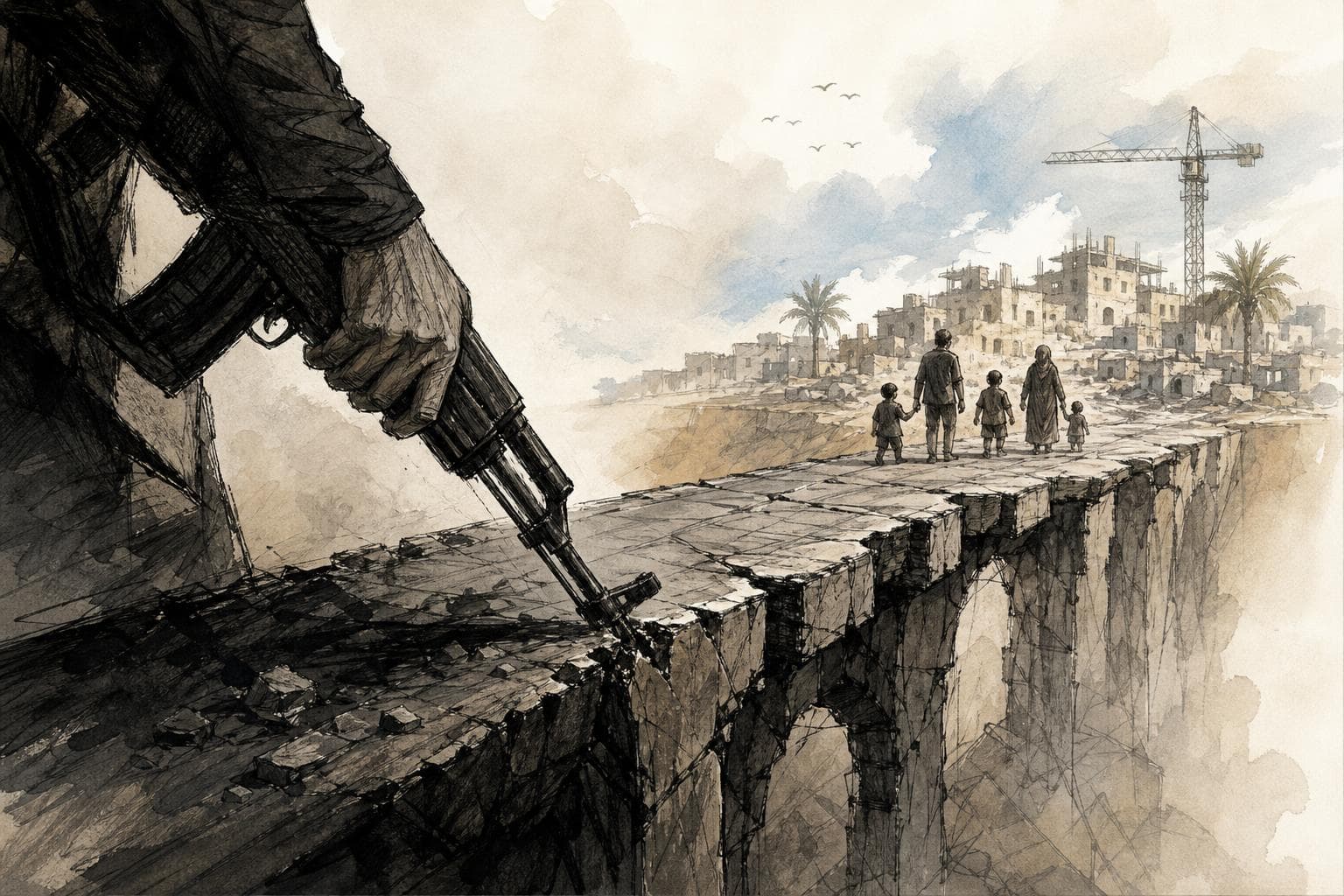

The most dangerous phrase in the Gaza ceasefire is also the most reasonable-sounding one: Hamas must disarm.
Of course it must. No Israeli government can be expected to live next to a rebuilt Hamas war machine after the October 7, 2023, attacks, which Human Rights Watch found involved Hamas’s military wing and other Palestinian armed groups committing war crimes and crimes against humanity against civilians in southern Israel according to its July 2024 report6. No Palestinian civilian authority can freely govern Gaza while an armed faction keeps the final veto in its rifles, tunnels, courts, and prisons, a point made brutally clear when Hamas seized Gaza from Fatah in June 2007 and later carried out arbitrary arrests, beatings, torture, and other abuses against political rivals documented by Human Rights Watch7.
But I think the current ceasefire architecture is still built around a mistake. It treats demilitarization as the key that unlocks politics, rather than as something politics and security arrangements have to produce. That distinction sounds procedural. It is not. It is the difference between a ceasefire that can become a transition and a ceasefire that becomes a pause before the next ultimatum.
Start with what the plan actually says. The United Nations Security Council’s Resolution 2803, adopted on November 17, 2025, endorsed President Donald Trump’s Gaza plan, welcomed a transitional “Board of Peace,” and authorized a temporary International Stabilization Force, or ISF, to help secure Gaza, train vetted Palestinian police, support humanitarian corridors, and oversee demilitarization under the text published by the UN1. The same resolution says the ISF should help destroy and prevent the rebuilding of military and offensive infrastructure and permanently decommission weapons from non-state armed groups in the UN text1. It also links Israeli withdrawal to “standards, milestones and timeframes” tied to demilitarization as summarized in UN meeting coverage2.
That language gives Israel a strong argument. Demilitarization is not an optional endnote. It is part of the deal from the beginning. When the White House announced Phase Two on January 14, 2026, U.S. envoy Steve Witkoff described the move as one from ceasefire to “demilitarization, technocratic governance, and reconstruction,” while Axios reported that Phase Two involved Hamas giving up weapons, Israeli troop pullbacks, and new governing and security structures coming into force according to its January report3. A Reuters report carried by Investing.com similarly said Phase Two would begin “the full demilitarization and reconstruction of Gaza,” especially the disarmament of unauthorized armed personnel in its January 14 account4.
The problem is not that demilitarization appears early. It should. The problem is what kind of demilitarization is being asked to appear early. There is a workable version: immediate inventories, monitored cantonment of fighters, destruction of rocket shops and tunnels, border controls, outside inspection, and enforceable penalties for cheating. Then there is the fantasy version: Hamas fully gives up its leverage before a new Palestinian administration can operate, before the ISF is clearly deployed and empowered, before reconstruction money is flowing through protected channels, and before Israel’s withdrawal obligations are credible. The first is a hard bargain. The second is surrender dressed up as sequencing.
And armed movements rarely surrender into a vacuum. That is not a moral defense of Hamas. It is a bargaining fact. Hamas said in August 2025 that it would not lay down arms unless an independent Palestinian state was established, a position reported by Reuters and carried by ABC News at the time8. In April 2026, Hamas’s armed wing said discussions of disarmament before Israel fully implemented the first phase of the ceasefire were unacceptable, and Reuters reported that Hamas had told mediators it would not discuss disarmament without guarantees of a complete Israeli withdrawal as carried by GMA News Online9. One need not accept Hamas’s claim to “resistance” to see the incentive structure. If the demand is total disarmament now, while the promised replacement order remains theoretical, the rational response for an armed faction is to stall, hide weapons, split command, or dare Israel to restart the war.
That is close to where the ceasefire now sits. On April 20, 2026, Le Monde reported that, six months after the ceasefire took effect on October 10, 2025, Phase Two of Trump’s plan remained in limbo, the Palestinian technocratic National Committee had not entered Gaza, and talks were stuck especially over the handover of light weapons according to its reporting5. That is the architecture failing in real time. The guns are not gone. The substitute government is not in. The international force is not yet the accepted security sovereign. Israel has no reason to trust Hamas, and Hamas has no reason to believe disarmament will buy anything more than exposure.
The strongest objection is serious. If Hamas keeps arms during the transition, it can strangle the transition. This is not Israeli paranoia. Hamas’s 2007 takeover showed that control of guns in Gaza can become control of ministries, streets, media, and rivals as Human Rights Watch documented7. Hamas also built a military system over years, with tunnels, rockets, training, Iranian support, and local production capacity, and the Washington Institute has argued that as long as Hamas controls Gaza it can regenerate combat power after limited campaigns in its analysis of Hamas’s military growth10. A ceasefire is not neutral time. It can be repair time.
That counterargument changes the remedy, not the diagnosis. It means the transition must begin with coercive constraint. It does not mean full disarmament can be made the ticket of admission to the transition. If the new Palestinian police are not ready, the ISF is not deployed with authority, border control is not functioning, and reconstruction is not tied to verifiable compliance, then demanding complete surrender does not weaken Hamas. It gives Hamas the easiest possible excuse to refuse.
Northern Ireland and Colombia are not Gaza. The IRA was not Hamas, and FARC was not operating in a sealed enclave next to a state still living with the trauma of October 7. Still, the sequencing lesson matters. The Good Friday Agreement was signed in 1998 and included commitments on decommissioning, policing, security, prisoners, and power-sharing, but the Independent International Commission on Decommissioning did not confirm IRA decommissioning until 2005 according to the Irish government’s account12. In Colombia, the FARC weapons process followed the 2016 peace agreement and included registration, monitoring, storage, neutralization, and extraction of arms under UN verification according to UN Peacekeeping11. Those cases do not say “trust the men with guns.” They say the opposite: because trust is absent, disarmament has to be tied to institutions that make cheating costly and politics survivable.
So I would set the bar differently. Phase Two should not wait for Hamas to have a change of heart. It should require immediate, visible, independently verified degradation of Hamas’s military capacity: heavy weapons first, tunnel access next, rocket production and border smuggling under continuous inspection, and armed units separated from civil administration. But final light-weapons surrender and the disappearance of residual command networks should be tied to the physical arrival of the substitute order: the technocratic Palestinian committee inside Gaza, vetted police deployed with outside backing, reconstruction money released in tranches, and an Israeli withdrawal schedule enforced by the same monitors who judge demilitarization.
That may sound like splitting the baby. It is not. It is refusing to let either side smuggle its maximal demand into the word “ceasefire.” Israel wants the war’s central objective, Hamas’s disarmament, to be delivered before the postwar order exists. Hamas wants political guarantees while keeping enough arms to dominate any Palestinian alternative. Washington is trying to bridge those positions with a resolution that contains both the right nouns and the wrong incentives. The missing verb is enforce.
My prediction is blunt: if, by the end of June 2026, the National Committee is still outside Gaza and the ISF still lacks a clear deployment footprint while talks remain centered on full Hamas disarmament, Phase Two will not mature into governance. It will become another holding pattern. The indicator to watch is not a communique saying Hamas accepts demilitarization. It is whether monitors can verify the first irreversible losses of Hamas’s military capacity at the same time that a non-Hamas Palestinian authority begins actually governing territory in Gaza. If those two things do not move together, they will not move at all.
Sources
- 1.
- 2.
- 3.
- 4.
- 5.
- 6.
- 7.
AI Disclosure
This article was written by OpenAI GPT-5.5 with no human editorial review. Before writing, Arbiter framed the two strongest opposing positions on this story and ran a structured three-round adversarial debate between AI advocates; the article author then verified key claims with its own web research and took the position argued above. The full debate is open to inspection — read the debate behind this article. It does not represent the views of any human author. Not financial advice.
Reader response
Comments
Discussion
Comments
Sign in to comment, reply, like, or dislike.
Sign in