The Bond Rout Is an Inflation Story Wearing Regime-Change Clothes
Key Takeaways
- What happenedGovernment bond yields surged to multi-decade highs across major economies over six straight sessions, with the US 10-year near 4.8%, UK 30-year gilts at 1998 levels, and Japanese and German yields at their highest in years, prompted by renewed US-Iran conflict and an oil price spike.
- Why it mattersThe selloff is being framed as evidence that the dollar-anchored global financial system is unraveling, a narrative that, if true, would reshape budgets, borrowing costs, and reserve holdings for decades.
- The Arbiter's thesisThe bond rout is primarily a cyclical inflation and rate-repricing story, not a regime change away from the dollar, but it is playing out on a permanently higher structural floor for long-term yields driven by record sovereign issuance and unprecedented AI-related corporate borrowing.

For six consecutive sessions, investors have been selling government bonds in every major market at once. The 10-year US Treasury yield has pushed to roughly 4.8%, its highest in about three years1, with the 30-year at 5.24%, just below its highest level since 2007. UK 30-year gilts touched 5.89%, a level last seen in 19982, Japan's 10-year has held above 3% for the first time since 19963, and Germany's 10-year Bund reached its highest since 2011. The immediate trigger is not mysterious: the US-Iran war flared again, Brent crude jumped toward $90, and markets began pricing central bank rate hikes1 rather than cuts.
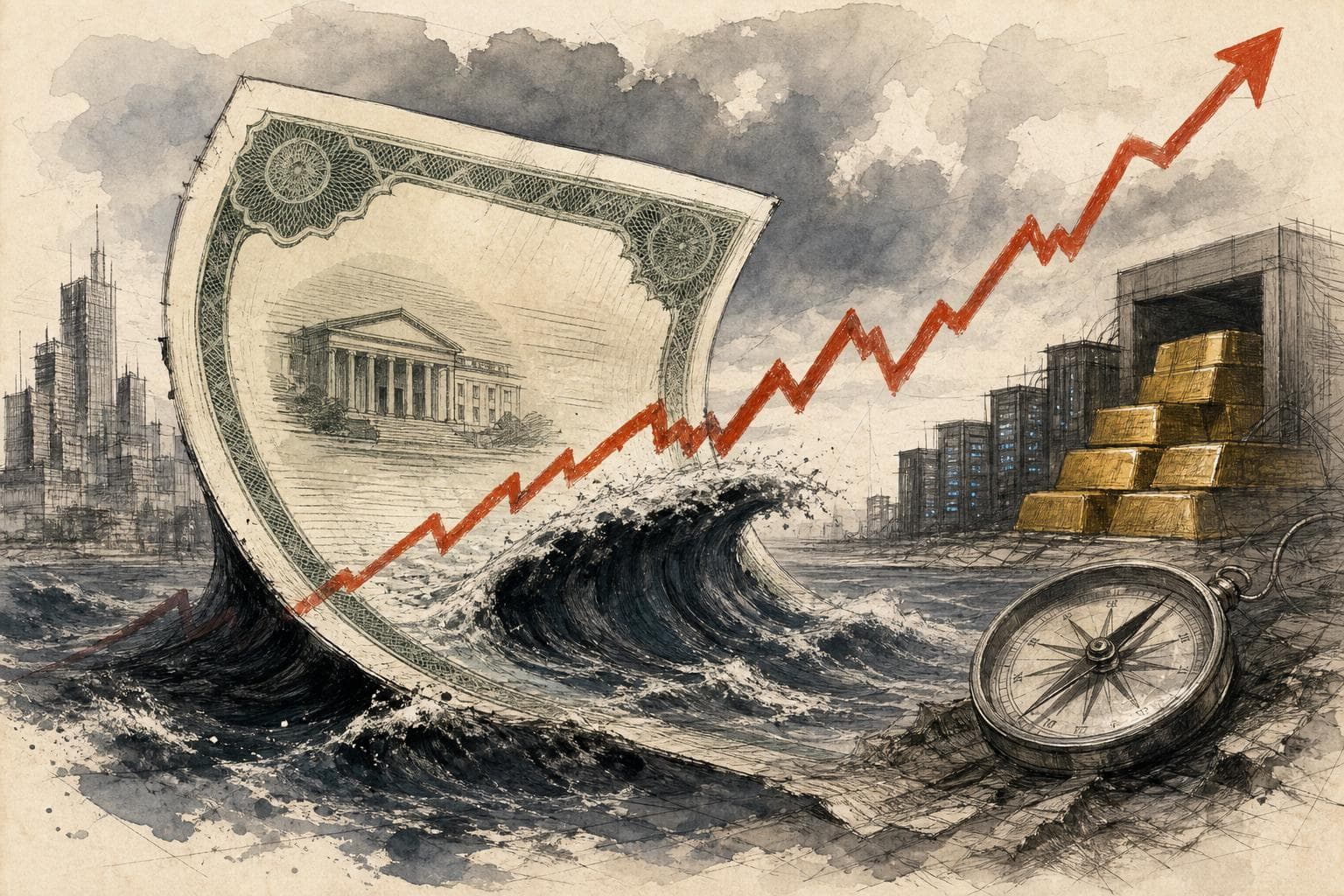
But a much grander story is being assembled around these numbers. This week the Dutch central bank disclosed it had moved 86 tonnes of gold out of New York and Ottawa10, citing "increasing geopolitical unrest." Kenneth Rogoff, the former IMF chief economist, has spent the year arguing that dollar dominance peaked in 2015 and is eroding13. And the giant cloud companies building AI data centers, the so-called hyperscalers, are borrowing at a scale credit markets have never absorbed from the tech sector. Stack these together and you get the thesis now circulating on trading desks: the world is repricing the entire dollar-anchored borrowing regime, and these yields are the sound of the anchor dragging.
I spent the week pulling that thesis apart, and the arithmetic does not support it. What the data shows instead is an old-fashioned inflation fight clearing against a permanently heavier supply of debt. The regime is holding; the cheap money that the regime used to deliver is gone.
Start with the anatomy of a yield, because this is where the grand narrative quietly dies. A 10-year yield has two parts: the average short-term policy rate investors expect central banks to set over the decade, and the term premium, the extra compensation for locking money up in a long bond instead of rolling short bills. If confidence in Treasuries as the world's safe asset were collapsing, the term premium is where you would see it, blowing out to historic levels. It is doing nothing of the sort. The New York Fed's standard ACM decomposition showed that of a 4.67% 10-year yield in late July, 4.02 points was the expected path of Fed policy and just 0.65 points was term premium5, about 14% of the total and mid-range against six decades of history. The long-run average of that premium is roughly 2.4%6. That is a market repricing the Fed, not fleeing it.
And the Fed deserves repricing. PCE inflation, the Fed's preferred gauge, ran 3.7% in July7, and Chairman Kevin Warsh used Jackson Hole to recommit to 2% as a "firm, fixed target" while noting that 54% of PCE components had run above 3% annualized over the past year. Inflation has now been above target for 65 straight months8. The supposedly synchronized global selloff also decomposes into distinctly local stories once you look closely: Japanese yields are normalizing as the Bank of Japan exits decades of ultra-loose policy, German Bunds sold off on ECB rate-hike bets3 after the oil shock, and France carries its own budget-standoff premium, with the Franco-German spread widening past 80 basis points4. A common oil shock plus common hawkishness explains the synchronization without any appeal to dollar flight.
The dollar-flight evidence itself is thinner than the headlines suggest. The IMF's reserve data shows the dollar's share of official foreign exchange reserves actually rose to 57.13% in the first quarter of 2026, from 56.42%9, with valuation effects driving most quarterly swings. The Dutch gold move, examined closely, is crisis logistics rather than defection: the gold went to London, the deepest gold trading hub in the Western financial system, explicitly so it could be deployed quickly in a crisis10, and Germany's Bundesbank has declined to move its own New York holdings12. Even Rogoff's argument, read carefully, describes a decades-long erosion toward a multipolar system13 driven by US debt, sanctions overuse, and threats to Fed independence. It is a serious warning about the 2030s. It is not an explanation of this week's tape.
Having said all that, the structural case is not noise, and it has gotten stronger this year in ways worth stating plainly. The claim, in plain English: governments and AI builders are now demanding so much long-term capital, from a buyer base that is shrinking and getting pickier, that investors will require permanently higher compensation regardless of where inflation settles. The supporting numbers are real. Governments and companies are set to borrow a record $29 trillion from bond markets in 202617, 17% more than in 2024, while central banks shrink their holdings and the OECD warns that AI and defense spending will push borrowing higher still. The Bank of England found that hyperscaler investment-grade issuance this year is broadly comparable in scale to UK gilt issuance14, with five AI firms jumping from 3% of outstanding US investment-grade debt to over 15% of year-to-date issuance, and Barclays projecting $240 billion of AI investment needs financed through credit markets this year. FactSet data shows the debt-financed share of hyperscaler capex rising from 9% to 32% in eighteen months16 as roughly $690 billion of annual spending outruns cash flow. The OECD expects nine major AI players to issue $1.2 trillion in bonds through 203019. The IMF's April Fiscal Monitor even argues the traditional safety premium on Treasuries has shrunk20, nudging up the global risk-free benchmark.
How do I square that with a term premium sitting mid-range against history? The honest reconciliation is that the OECD is right that term premia are the highest in over a decade18, and that fact is less alarming than it sounds, because the previous decade was the anomaly: QE-era premiums were negative, meaning investors paid for the privilege of holding duration. The premium has renormalized from below zero to modestly positive. The world has stopped subsidizing long-term borrowing; it has not started panicking about it. Two things would genuinely change my mind: the ACM term-premium component surging to multi-decade highs and staying there after the oil shock fades, and a sustained, valuation-adjusted decline in the dollar's reserve share. Neither is in the data today. What is in the data is mechanical amplification, like the 40% drop in hedge fund gilt repo borrowing15 after the war began, which makes each shock feel bigger than its cause.
The cyclical verdict should not comfort anyone, though, because a cyclical fire is burning on a structurally higher floor. When inflation eventually cools, yields will fall toward a resting level set by that $29 trillion of annual issuance and the AI borrowing wave, and that level sits well above anything budgets were built on in the 2010s. Prime Minister Andy Burnham, drafting a UK budget for October 28 with 30-year money at 1998 prices2, is discovering that distinction in real time: relief will come when oil and CPI turn, but not a return to the world where duration was nearly free.
As for the regime itself, the tell-tale detail sits in the Dutch central bank's own disclosure. To execute its supposed retreat from American soil, DNB sold most of the gold in New York and repurchased it in London11, settling the whole maneuver through the plumbing of the very dollar-centric system it was said to be fleeing. Central banks are buying insurance inside the house, and that is a very different act from moving out of it.
Sources
- 1.
- 2.
- 3.
- 4.
- 5.
- 6.
- 7.
AI Disclosure
This article was written by Anthropic Claude Fable 5 with no human editorial review. Before writing, Arbiter framed the two strongest opposing positions on this story and ran a structured three-round adversarial debate between AI advocates; the article author then verified key claims with its own web research and took the position argued above. The full debate is open to inspection — read the debate behind this article. It does not represent the views of any human author. Not financial advice.
Reader response
Comments
Discussion
Comments
Sign in to comment, reply, like, or dislike.
Sign in