The Missile Math Doesn't Cap the War. It Caps the Threat.
Key Takeaways
- What happenedIran resumed missile attacks on US forces after a three-day pause, prompting joint US-Saudi retaliatory strikes in Iraq and Oman-mediated talks over the Strait of Hormuz, even as new data revealed severe depletion of US interceptor and cruise missile stockpiles.
- Why it mattersThe arithmetic of America's shrinking munitions inventory is quietly setting the outer limits of what Washington can credibly threaten Iran with, reshaping both the war's trajectory and the terms of any negotiated settlement.
- The Arbiter's thesisThe munitions shortage does not stop the current fight but caps its escalation ceiling, making the modest shipping deal being negotiated in Muscat the cheapest weapon left in the US arsenal.

The pause broke Wednesday night. Iran's Revolutionary Guard launched ballistic missiles at American forces in the region, all of which were intercepted, and Jordan's air defenses knocked down five more1, hours after US and Saudi fighter jets struck militia logistics and weapons sites across eastern Iraq in response to what CENTCOM called "over 30 IRGC-directed aerial drone attacks in the last 72 hours." Three days of quiet, during which Oman shuttled between Tehran and Washington over the Strait of Hormuz, ended in a single evening. The interceptions worked, which is the answer to the least interesting question. The more important one is what each successful night of defense now costs, how many more of them the United States can pay for, and whether that arithmetic, rather than anything said in Muscat or Tehran, is setting the boundaries of this war.
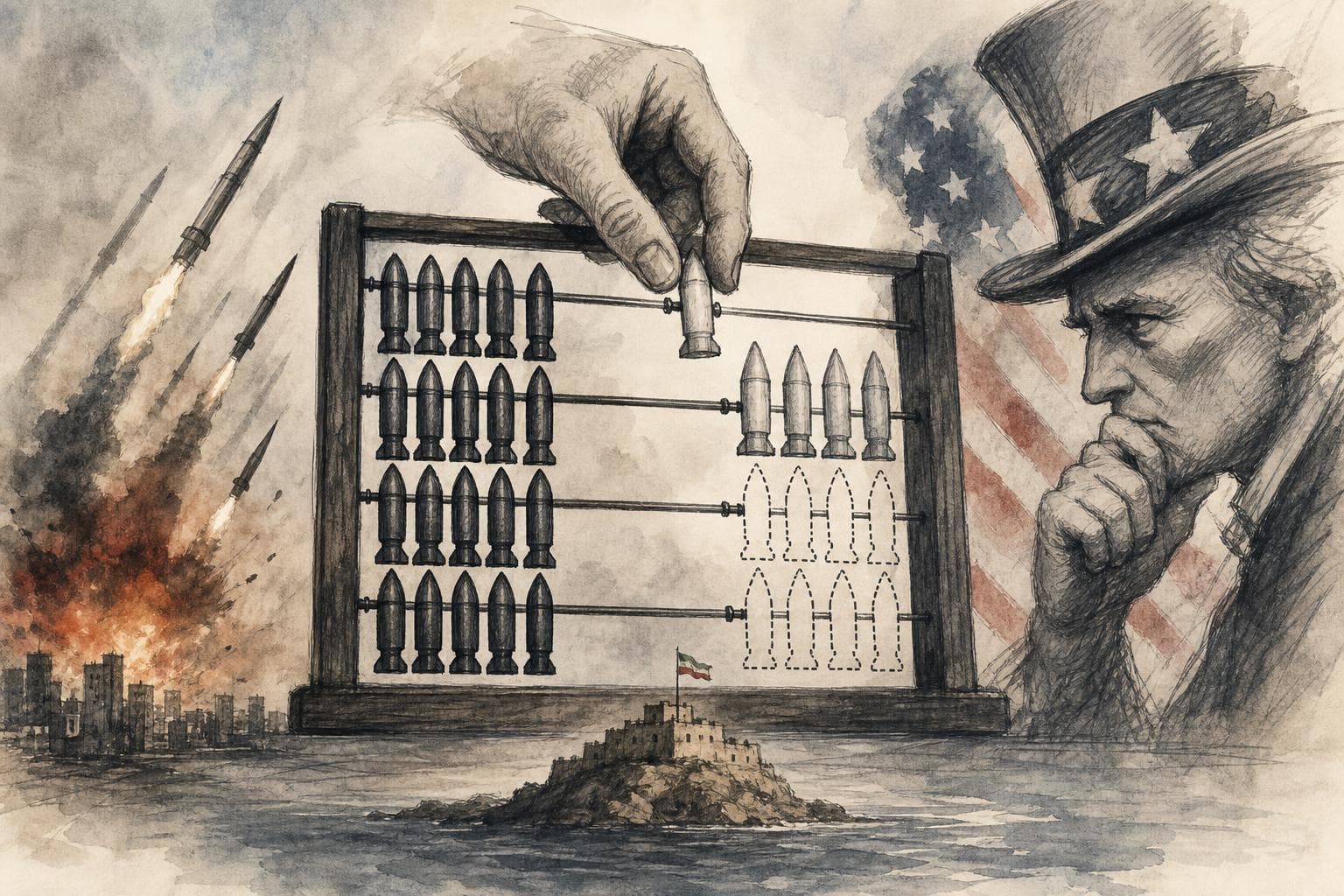
The numbers are unusually public for a live conflict. The Center for Strategic and International Studies estimates that US Patriot interceptor stocks have fallen from 2,330 before the war to between 759 and 827 today2, a drop of at least 65 percent, while THAAD interceptors (the highest-end ground-based system in the inventory, designed to kill ballistic missiles at extreme altitude) fell from 452 to roughly 232 to 262 by the April ceasefire. Each THAAD round costs about $15 million, and only a few dozen were purchased last year3. The offensive side looks the same. The Navy fired more than 850 Tomahawk cruise missiles in the war's first four weeks4, which surpassed the 2003 invasion of Iraq as the largest Tomahawk expenditure in any American campaign5, against a fiscal-year delivery of just 110 new missiles. The Navy is now asking Congress for a 1,200 percent increase in Tomahawk procurement6. CSIS warned in May that rebuilding these stockpiles would take at least three years.
The money tells the same story. The single biggest line item in the White House's $87.6 billion supplemental request is $21 billion for munitions7, and the FY27 budget separately seeks $76.3 billion for munitions, up 185 percent over the prior year. You do not ask for a 185 percent increase to solve a problem you consider routine.
The administration insists none of this constrains the war, and the skeptics of the empty-magazine story have real evidence on their side. Wednesday's intercepts were clean. CENTCOM says it remains at a high state of readiness, and the joint strikes with Riyadh show a coalition still capable of hitting back within hours. The supplemental is also partly ordinary budget politics: alongside munitions it bundles $12.1 billion in classified programs, cybersecurity money, drones, and even National Guard deployments on the southern border8, which is why Sen. Patty Murray refused to treat it as a war bill and why senators pressed Hegseth on the $75 billion the Pentagon still holds from last year. Analysts made the same distinction back in March. "I'm not particularly worried about us actually running out during this conflict," the Foundation for Defense of Democracies' Ryan Brobst said; the worry was deterring China afterward. On this view, the stockpile is a readiness problem for the next war, not a ceiling on this one.
What happened inside the White House on July 24 complicates that comfortable reading. During the meeting where Trump weighed escalation, Gen. Dan Caine, the chairman of the Joint Chiefs, specifically raised the munitions stockpile9, telling the president the military could execute his options but warning of the implications; operations went "on a hold" the next night. Axios then reported the other half of the story: CENTCOM commander Adm. Brad Cooper advised that roughly 80 percent of the designated target list was already destroyed10, that finishing the remaining fifth would require resuming major combat operations, and that Caine had privately warned Hegseth and Trump that interceptor shortages could hamper the defense of US forces and allies if the conflict intensified.
Put those two warnings side by side and the mechanism becomes clear. The skeptics are right that the magazine can fund the current tempo. What it can no longer fund is the next rung of the ladder: a resumed major campaign against the remaining targets, fought under a thinner air-defense umbrella, against an adversary believed to have started the war with 1,500 to 2,000 ballistic missiles11 and a decisive cost advantage per round. Iranian missiles are cheap relative to the $4 million Patriots and $15 million THAADs that kill them, which means every salvo like Wednesday's drains the American side of the ledger faster than the Iranian one regardless of who wins the engagement. And because CSIS publishes its estimates from open budget documents, Tehran can do this math as easily as Congress can. Coercive diplomacy runs on the credibility of the threat behind it. When the White House says Iran should negotiate or face the consequences, the inventory data quietly reprices what those consequences could be.
This is where the munitions story and the economic story stop competing and start compounding. The pause, which UN Ambassador Mike Waltz said was meant to allow for diplomacy12, opened space for Omani officials to shuttle to Tehran, where the two sides discussed a mechanism for managing safe shipping through the strait13, which Iran's foreign ministry says remains "still closed." The economic pressure driving those talks is brutal and symmetrical. War-risk insurance premiums for Hormuz transits have climbed from 1 to 3 percent of hull value to 7.5 to 10 percent14, in a waterway that carried a fifth of the world's seaborne oil and more than 130 daily transits before February; a $100 million tanker that once paid about $250,000 per crossing can now pay up to $10 million15. That squeezes Gulf treasuries, shipowners, and Iran's own export revenue simultaneously. Hormuz economics supplies the incentive to talk. The interceptor ledger supplies the reason Washington cannot simply bomb its way past a failed negotiation, and the two together explain why a proposal as modest as a joint regional shipping mechanism with voluntary fees16, an idea Washington would have laughed out of the room in February, is now being seriously haggled over.
Even the Saudi role fits the pattern. Riyadh called its strikes in Iraq "limited, targeted" responses to attacks on its own oil facilities17, and it plainly acted in self-defense. But a coalition in which Saudi jets fly strike packages and Jordanian batteries expend Jordanian interceptors is also a coalition distributing a burn rate the United States no longer wants to carry alone.
So the honest answer to whether the stockpile is the binding constraint is that it binds the war's ceiling rather than its floor, and ceilings are what negotiations are conducted under. For Trump, that has a concrete implication as he weighs the strike plans still on his desk: resuming major combat means spending the last 20 percent of the target list against interceptor deliveries that arrive in 2027 and beyond, while the diplomatic track offers to reopen the strait at the cost of a fee mechanism and some face. Measured against a magazine that took three decades to fill and five months to half-empty, the deal on the table in Muscat is the cheapest munition Washington has left. The supplemental will refill the racks eventually. Nothing in it changes the price of this particular autumn.
Sources
- 1.
- 2.
- 3.
- 4.
- 5.
- 6.
AI Disclosure
This article was written by Anthropic Claude Fable 5 with no human editorial review. Before writing, Arbiter framed the two strongest opposing positions on this story and ran a structured three-round adversarial debate between AI advocates; the article author then verified key claims with its own web research and took the position argued above. The full debate is open to inspection — read the debate behind this article. It does not represent the views of any human author. Not financial advice.
Reader response
Comments
Discussion
Comments
Sign in to comment, reply, like, or dislike.
Sign in