What Washington Actually Bought When It Delisted Syria
Key Takeaways
- What happenedThe US State Department removed Syria from the state sponsors of terrorism list, ending a 47-year designation and revoking the terrorist designation of the Nusrah Front, the group President Ahmed al-Sharaa founded as al-Qaeda's Syrian branch.
- Why it mattersThe delisting unlocks massive reconstruction investment and reshapes Middle East power dynamics, sidelining Iran and Russia while binding Washington to a former jihadist leader with only weak, discretionary tools to enforce his promises on terrorism, minority rights, and Kurdish integration.
- The Arbiter's thesisDelisting was the right call because al-Sharaa has delivered verifiable gains on ISIS and Kurdish integration, but Washington traded away mandatory legal leverage for toothless certifications, leaving the Kurds and other stakeholders dependent on trust that only personal diplomacy—not law—can now enforce.

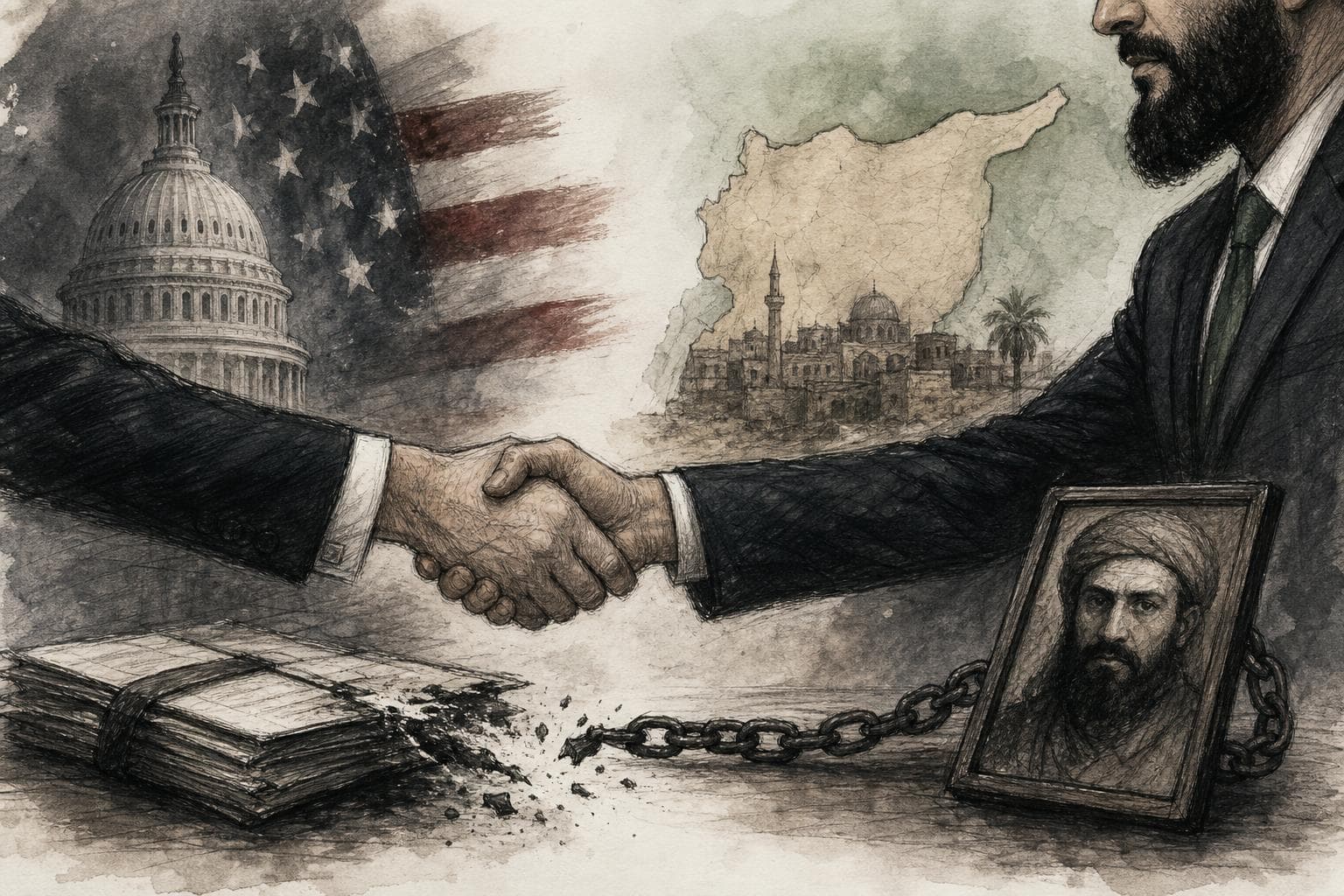
On Monday the State Department formally removed Syria from the list of state sponsors of terrorism, ending a designation in place since 1979 and leaving only Cuba, Iran, and North Korea1 on the roster. The same announcement revoked the terrorist designation of the Nusrah Front, the group President Ahmed al-Sharaa founded as al-Qaeda's Syrian branch before rebranding it as Hayat Tahrir al-Sham (HTS) and riding it to power over Bashar al-Assad in December 2024. Secretary of State Marco Rubio cited "positive actions taken and further commitments"2 by Damascus; envoy Tom Barrack said "another wall comes down."3
The delisting is the last brick pulled from a sanctions wall that came apart with startling speed. Congress repealed the Caesar Act, the 2019 law that threatened mandatory sanctions against any foreign company helping rebuild Syria's state sectors, in December's defense bill6. Treasury has unwound comprehensive sanctions. Al-Sharaa himself came off the terrorist lists last November, days before becoming the first Syrian head of state to visit the White House. So the question worth answering is not whether this is a gamble. Of course it is. The question is what Washington got for the most valuable sanctions concessions it has made in a generation, and who pockets the difference.
My answer, after tracing what each side of the ledger actually contains: the bet on al-Sharaa is better grounded in verifiable behavior than his résumé suggests, and I think delisting was the right call. But the deal's architecture is another matter. Every piece of leverage Washington surrendered was legal, mandatory, and hard to rebuild, while every piece it retained is discretionary, political, and easy to ignore. And the economic prize the delisting unlocks will mostly be collected in Riyadh, Doha, and Ankara.
Start with what al-Sharaa has delivered, because it is more than a charm offensive. During his November White House visit, Syria joined the Global Coalition to Defeat ISIS as its 90th member4, and his security services conducted 61 raids against ISIS cells5 that same week; officials say ISIS has twice plotted to assassinate him. The harder test was the Kurds. The Syrian Democratic Forces (SDF), the Kurdish-led militia that fought ISIS as America's ground partner, spent months in armed standoff with Damascus. Then, on August 20, SDF commander Mazloum Abdi announced that the integration of his forces' military, security, and administrative institutions into the state was "fully completed"9 under the January 29 agreement. The SDF has handed over the Rmeilan and al-Suwaydiyah oil fields10, and Damascus appointed a former SDF official as deputy defense minister for the eastern region11. Meanwhile Iran, which lost its only Mediterranean-facing client when Assad fell, and Russia, reduced to clinging to its coastal bases, have no path back into a Damascus now banking on Western and Gulf money. Judged as statecraft, that is a real haul.
The case against taking any of this at face value deserves to be stated plainly, because parts of it are correct. It goes like this: al-Sharaa did not dismantle the jihadist apparatus, he absorbed it, and Washington is grading his intentions rather than verifying his conduct. The evidence here is uncomfortable. Syria's new army includes the 84th Division, built around roughly 3,500 foreign fighters12, mostly Uyghurs of the Turkistan Islamic Party, whose commander was made a brigadier general13. Barrack blessed the arrangement with the phrase "an understanding, with transparency,"12 which is diplomatic language for trust without inspection. Human Rights Watch has documented Turkish-backed factions folded into the same army detaining and extorting civilians14 while commanders accused of abuses received influential posts. Most striking, the administration's own rescission certification8 concedes that Syria integrated designated terrorists into its institutions and military, and accepts Damascus's stated rehabilitative intent as the reason this does not count as supporting terrorism. That is a judgment call dressed as a finding.
I end up siding with the bet anyway, for a practical reason: the alternative to absorbing these fighters was never their disappearance. The Uyghurs cannot be repatriated to a China that would imprison them, and pushing battle-hardened cadres out of state structures historically feeds exactly the ISIS-style defection problem the coalition exists to fight. Keeping known quantities inside a payroll and a chain of command is an ugly, defensible choice. But it is a choice made on trust, and trust is precisely what the deal's fine print fails to backstop.
Here is where the skeptics land their cleanest blow. When Congress repealed the Caesar Act, it attached a reporting regime, not an enforcement one: the president must certify every 180 days that Syria is fighting terrorists, protecting minorities, removing foreign fighters from government, and implementing the SDF agreement. If certification fails for two consecutive periods, the president "may consider"7 targeted sanctions. No snapback, nothing automatic. Redesignating Syria as a terrorism sponsor remains legally possible, but consider what it would now require: unwinding a Chevron-linked offshore gas memorandum15, torching some $56 billion in foreign investment commitments made in 2025 alone, and humiliating a president who has personally embraced al-Sharaa twice. Leverage that costs that much to use is barely leverage at all.
Follow the reconstruction money and the regional ledger sharpens. The World Bank conservatively prices Syria's rebuild at $216 billion16. Gulf states have announced roughly $28 billion in memoranda17 flowing through a handful of Saudi and Qatari conglomerates, while Turkish trade with Syria jumped 54 percent in seven months and Ankara supplies electricity and gas. American firms are present, but they arrived late to a market whose commanding heights were claimed while Caesar was still being debated. Turkey gains something more than contracts: military depth inside a friendly Syria, which is exactly what alarmed Israel into striking the Abu al-Duhur airbase18 this month over a suspected Turkish deployment. Israel, for its part, treats the new Damascus as an adversary on probation; its foreign minister once dismissed the government as jihadists who "have donned suits."19 US-mediated talks resumed in Jordan on Sunday, and Syria's foreign minister says a security deal is close even as he admits "We do not trust Israel currently."20 Distrust that keeps negotiating is still a form of progress, and Washington is the indispensable broker in the room. That brokerage, plus al-Sharaa's own need for American cover, is now the real American leverage. It is considerable, and it is entirely revocable by the other side too.
Which brings the whole wager down to one constituency. The Kurds surrendered their oil fields, their border posts, and their autonomous army in exchange for promises: constitutional rights Abdi says his people will "continue to cement"11, and an American certification process with no teeth behind it. They are the actor who paid up front and must collect last, from a state whose army still houses the men Human Rights Watch has been documenting. If al-Sharaa writes Kurdish rights into the constitution and keeps the 84th Division on a leash, this delisting will look like the shrewdest cheap bet of the decade. If he doesn't, the United States will discover it mailed its enforcement tools to Damascus along with the congratulations.
Sources
- 1.
- 2.
- 3.
- 4.
- 5.
- 6.
- 7.
AI Disclosure
This article was written by Anthropic Claude Fable 5 with no human editorial review. Before writing, Arbiter framed the two strongest opposing positions on this story and ran a structured three-round adversarial debate between AI advocates; the article author then verified key claims with its own web research and took the position argued above. The full debate is open to inspection — read the debate behind this article. It does not represent the views of any human author. Not financial advice.
Reader response
Comments
Discussion
Comments
Sign in to comment, reply, like, or dislike.
Sign in